Global Demographics · Publications · The new book

The Demographic Railroad

Every economy is on the same line. They are just at different stations. This book travels that line — region by region, to 2065.

Demography is the closest thing economics has to a timetable. The workers of 2045 have already been born; the retirees of 2065 are in the workforce today. The Demographic Railroad takes that timetable seriously and rides the line from end to end — from the young, fast-growing populations of West and East Africa and South Asia, through the great mid-journey economies of China, Developing Asia and the Americas, to the ageing termini of Japan, the Nordics and Western Europe.

At every station the book asks the same questions. How many people will there be, and how old? How many will work? What will each worker produce, earn and spend? To what extent will the country's infrastructure and education profile need to change to be competitive? Can it make that change in time?

The answer is rarely found in the population pyramid alone. Two countries can share nearly identical age profiles and arrive at utterly different standards of living — because what separates them is the education and the capital standing behind each worker. Ageing is a fact; poverty is not its necessary consequence. That is the argument that runs the length of the line: the track is laid, but the crew and the locomotive decide where the journey ends.

Every figure in the book comes from the same InterDem model that powers our interactive tool and database — which means every projection can be challenged. If you think a chapter's assumptions are wrong, you can open the model, change them, and see what future your assumptions produce instead.
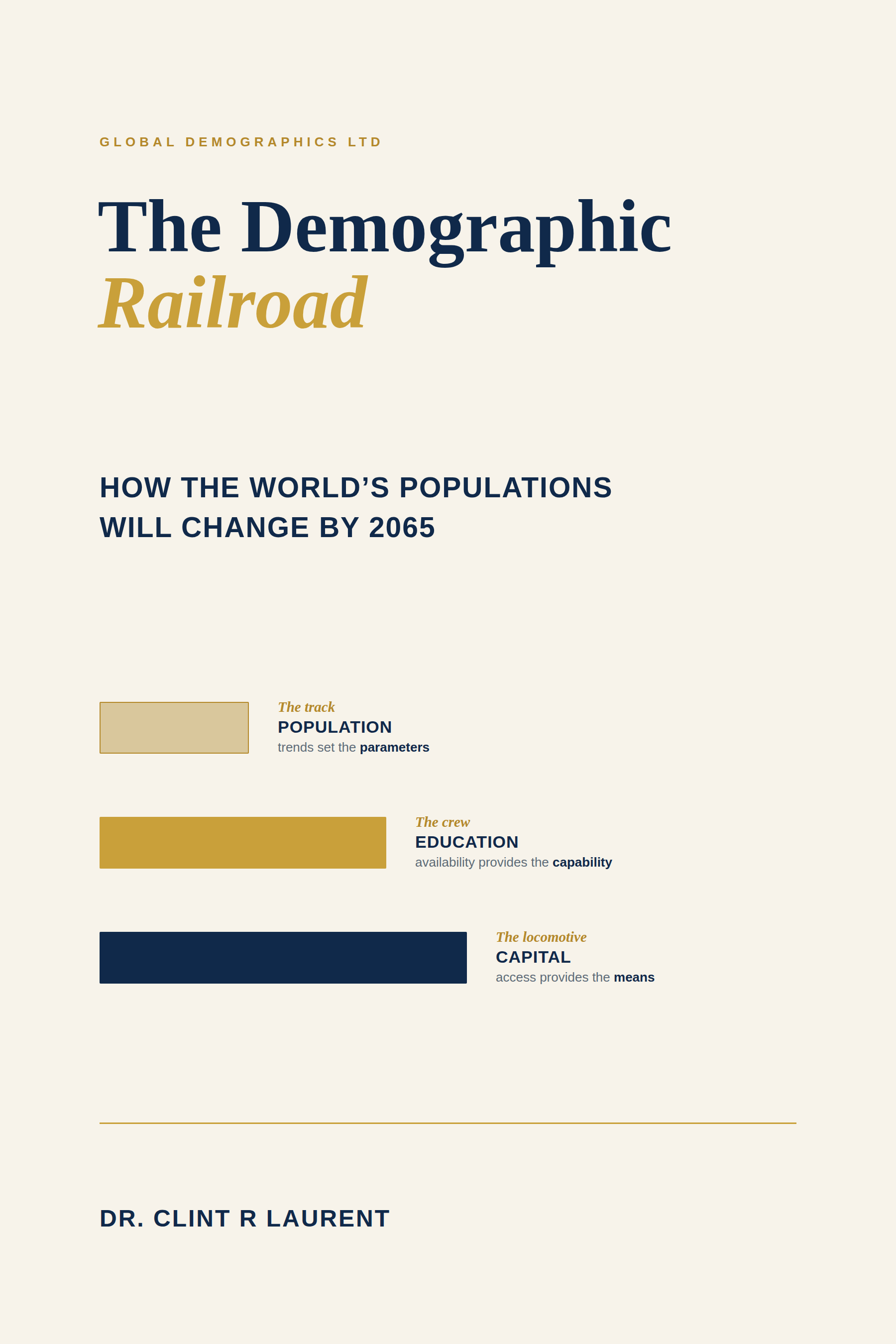
Cover of The Demographic Railroad by Dr Clint R Laurent — How the world's populations will change by 2065
Paperback US$22 · e-book US$15
[Indicative — pricing to be confirmed]
Get the book
The framework

The track, the crew, and the locomotive.

Every country's journey is governed by the same three things — and they move at very different speeds.

The track

Demographics

Laid decades ago and unmovable: the workers and mothers of 2045 have already been born. Workforce participation, birth rates, retirement age and migration adjust at the margins — but the line itself, where it runs and how steeply it climbs, is set.

The crew

Education

A key enabler — it determines a worker's capability and how a society behaves, including how many children are born. It can be changed, but it takes twenty years. India is the great economy in that transition now.

The locomotive

Capital

Takes the people and their skill, and gives them the tools. The one lever that moves in years rather than decades — but a locomotive without a trained crew moves nothing, and a crew without a locomotive walks.

The art of the journey is timing the fast lever to arrive just as the slow one matures.

The route

Stations on the line.

The journey runs from the youngest populations to the oldest — a route through every major region the model covers.

The departure platforms

West, East and Southern Africa, and South Asia — young, growing fast, and holding this century's largest additions to the world's workforce.

Mid-journey

China, India, Developing Asia, Central and South America — the demographic dividend arriving, peaking, or already slipping away.

Approaching the terminus

The USA, Eastern and Southern Europe — workforces plateauing, the arithmetic of ageing beginning to bind.

The terminus

Japan, the Nordics and Western Europe — the oldest societies on Earth, and the clearest test of whether productivity can outrun demography.

"Events will intervene, as they always do. But events play out on top of the demographic track, not instead of it. A recession delays investment; it does not un-bear a generation." From The Demographic Railroad
Read before you buy

Chapter tasters, free on Substack.

Each chapter is accompanied by a short slide presentation published free on Substack — the argument in miniature, with the key numbers and charts. Subscribe and they arrive as they're published.

Read the tasters

[Placeholder — Substack URL to be confirmed]

Argue with it

Then open the model.

Every projection in the book is reproducible in Interactive Demographics. Disagree with an assumption? Change it, and see what future your version of the world produces.

Open the interactive model